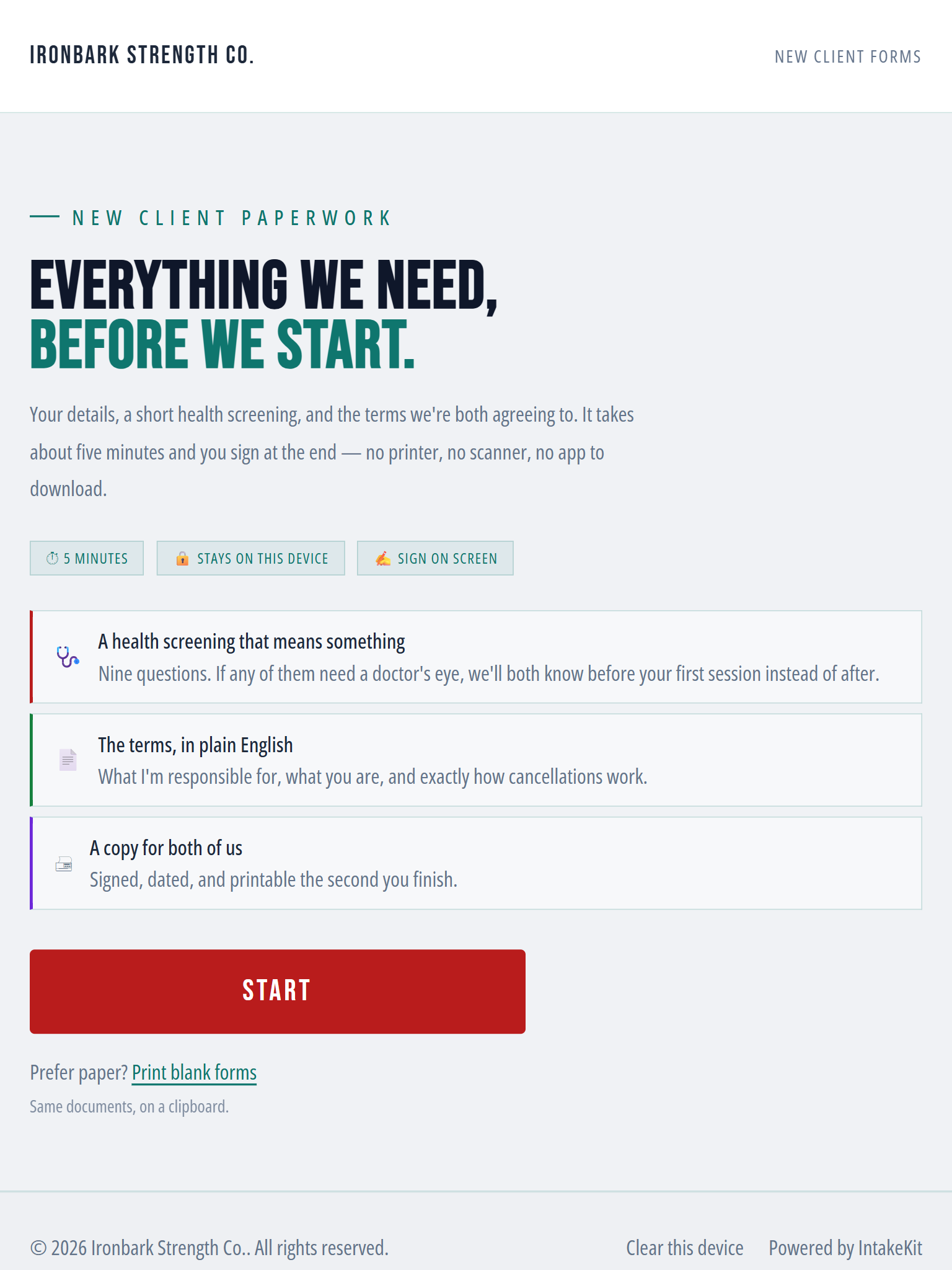
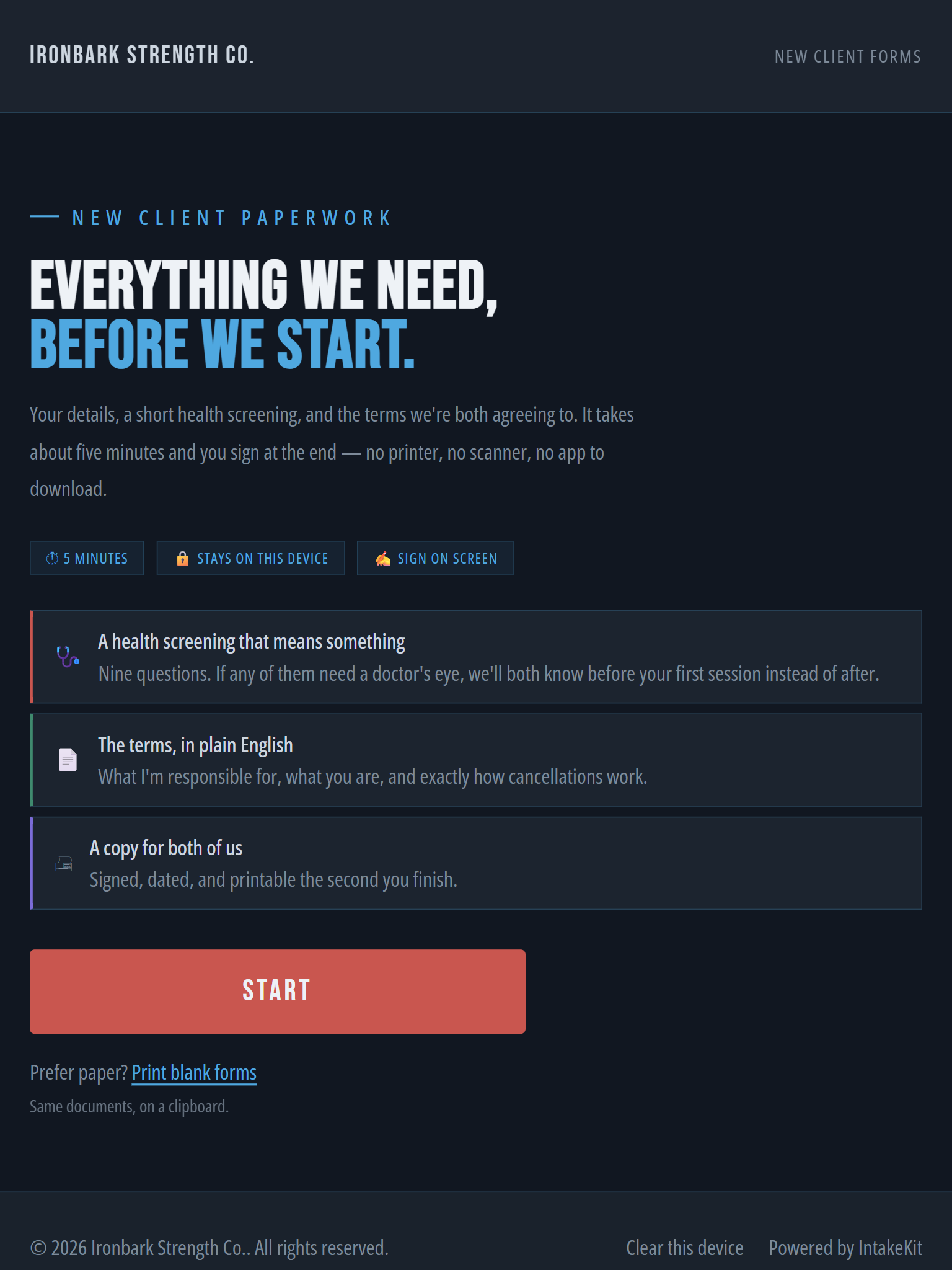
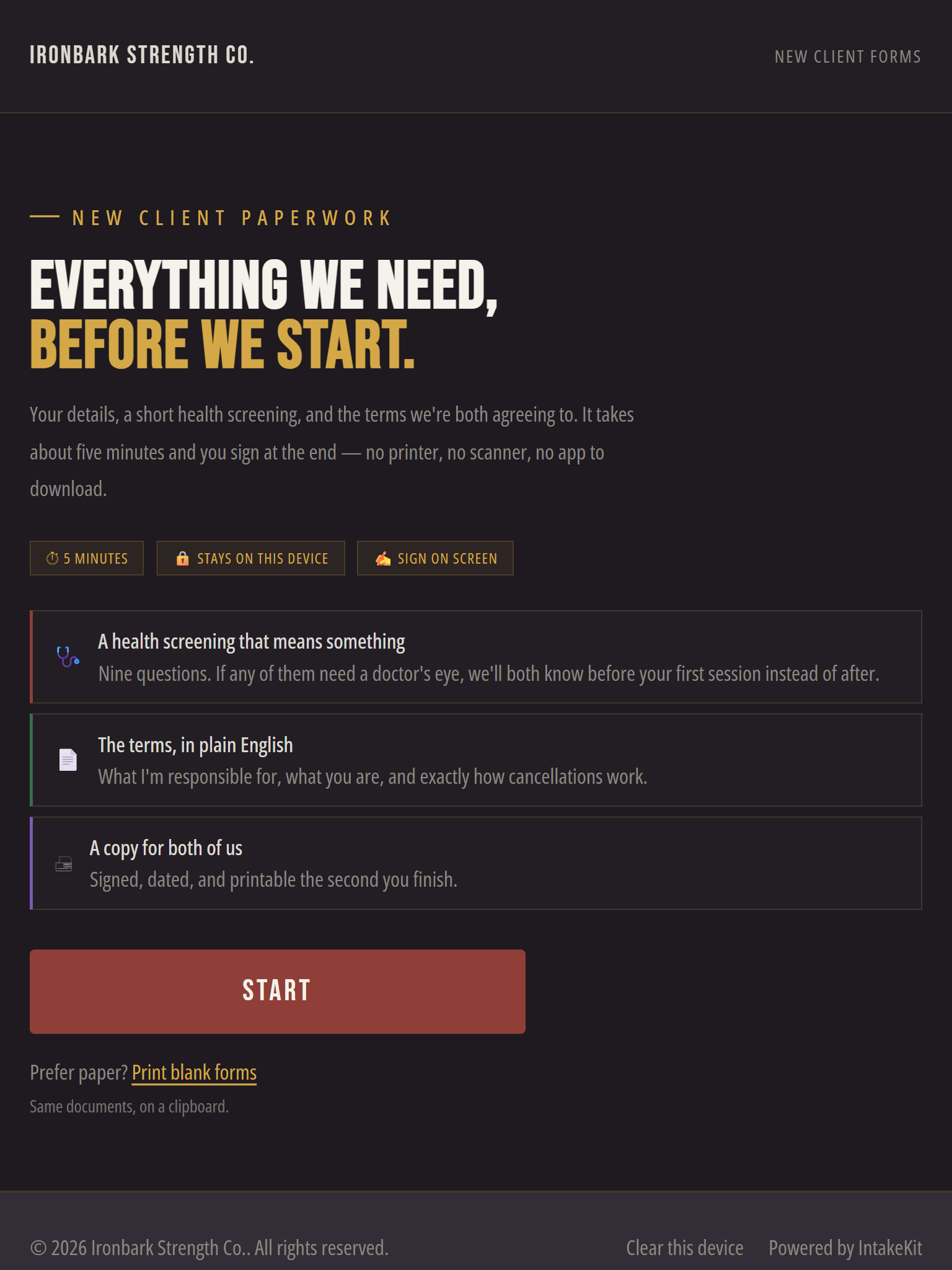
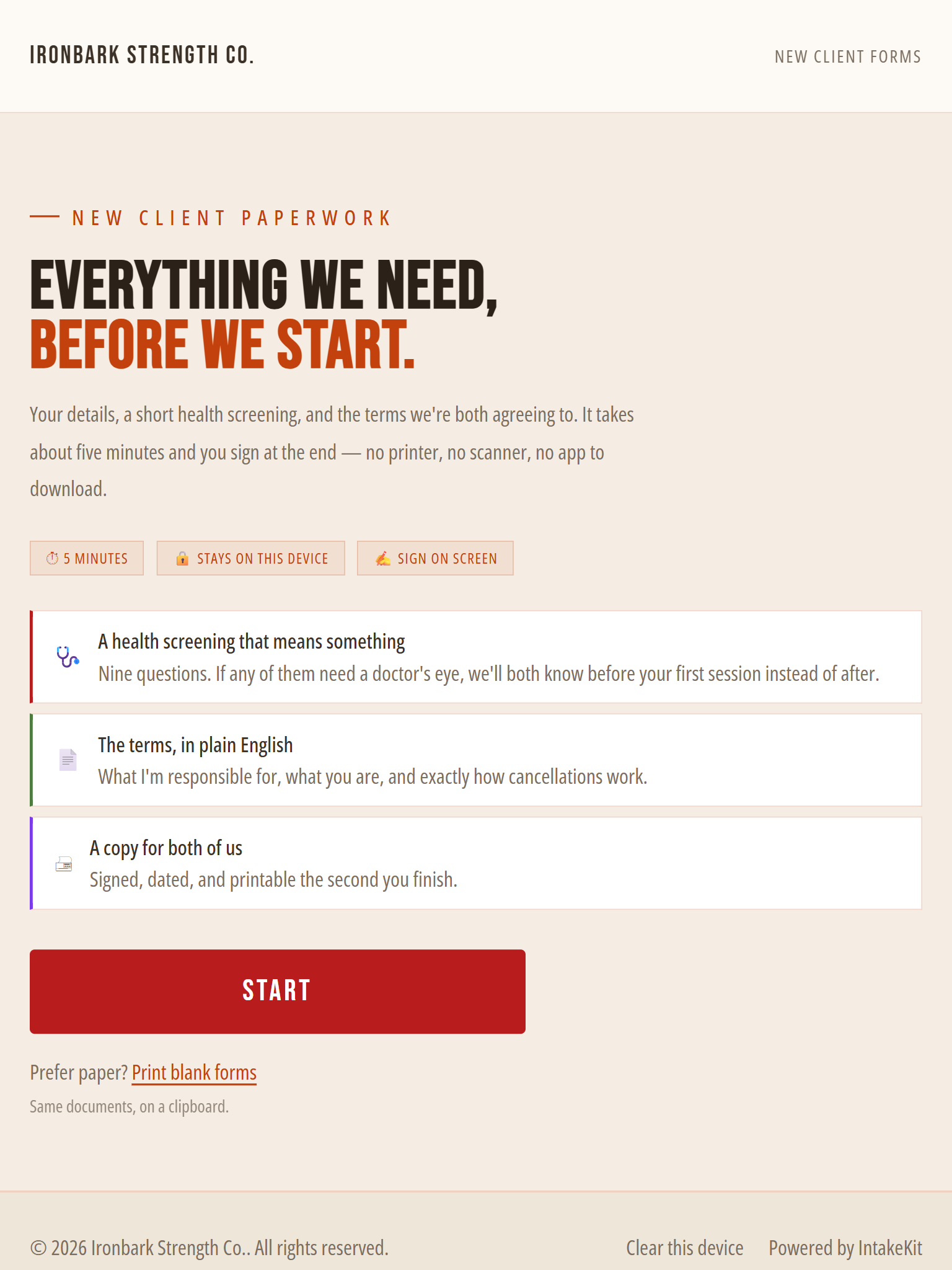
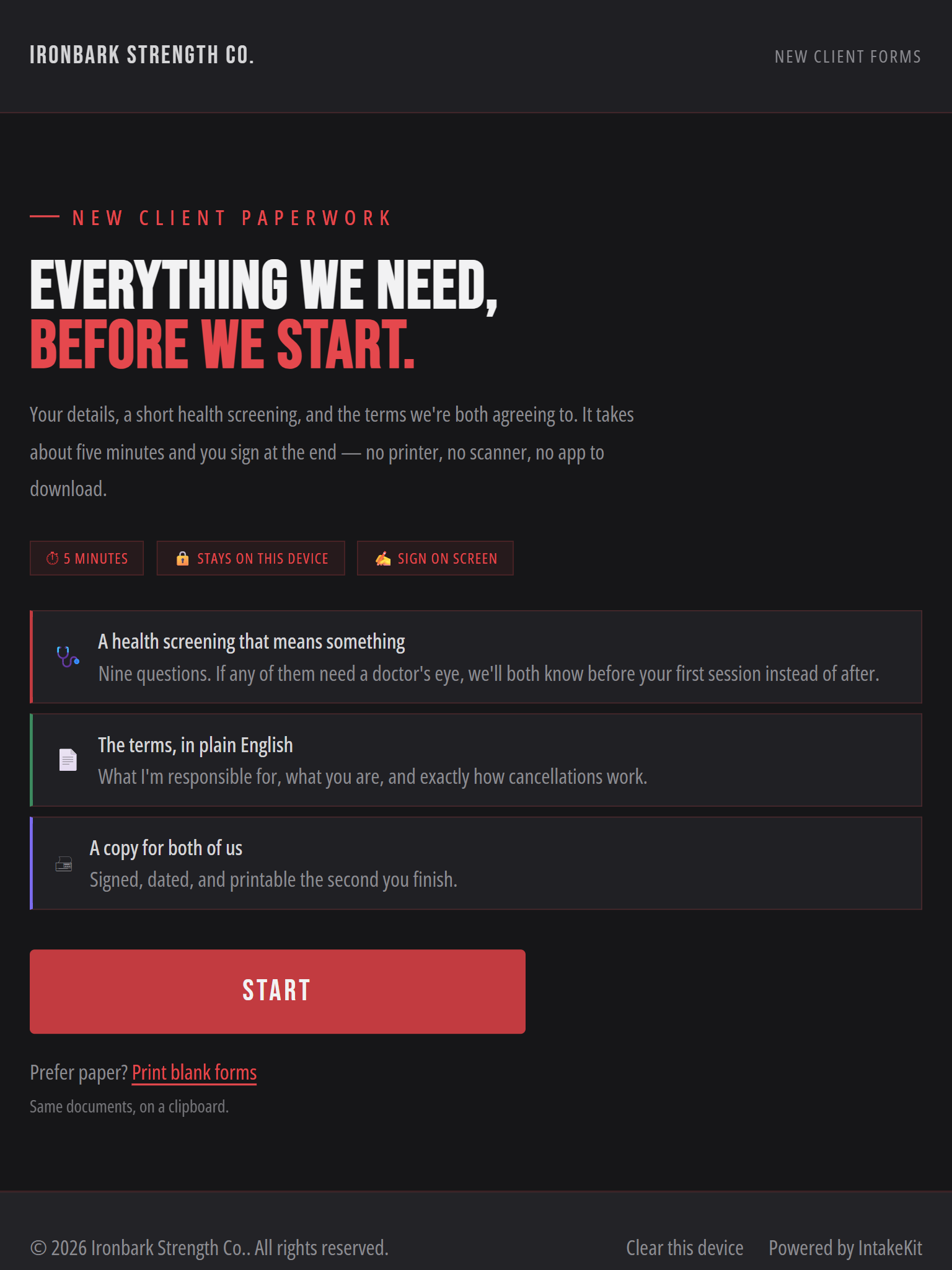
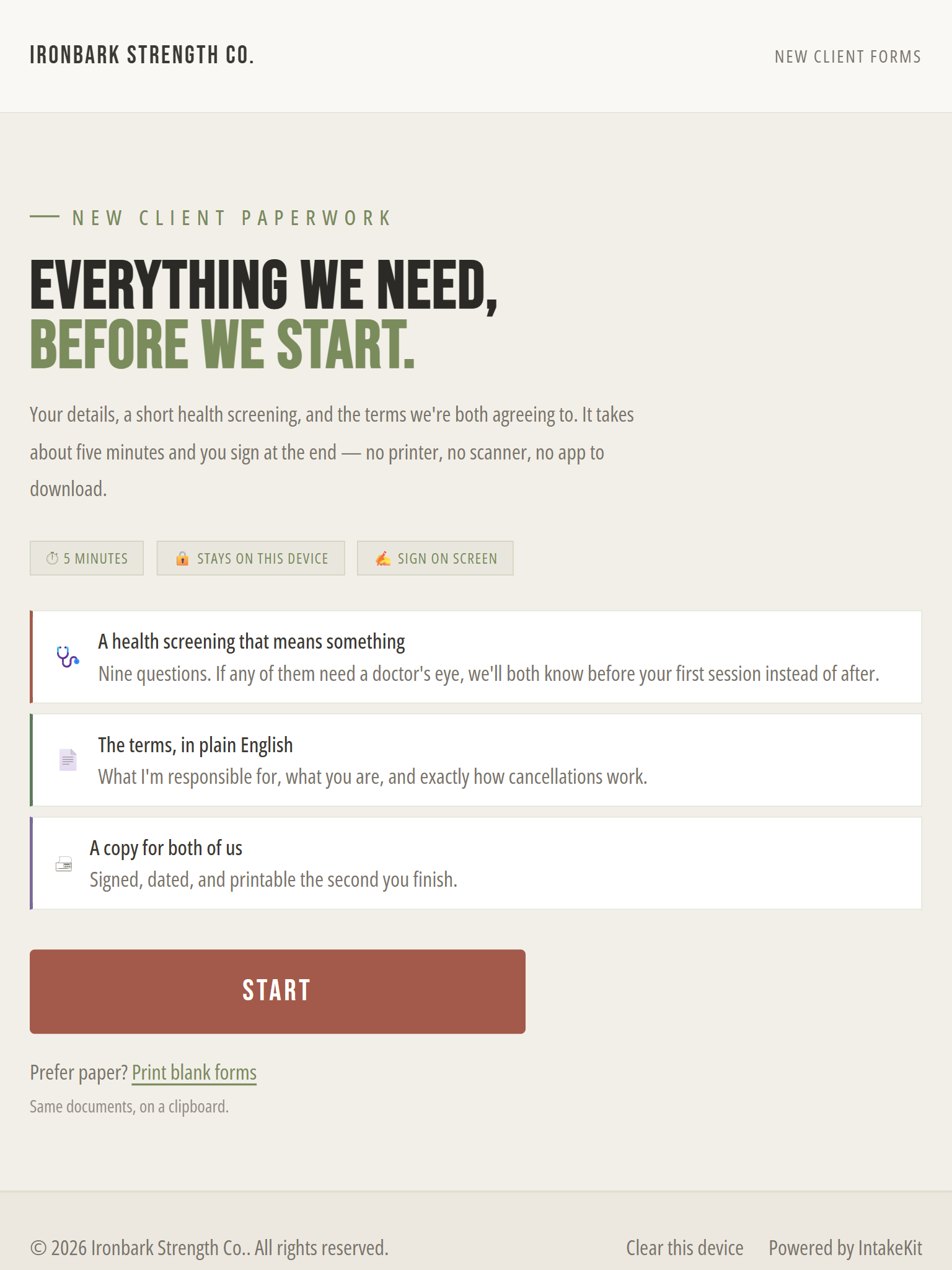
Intake, health screening, consent, waiver and your own policies — on the tablet you already carry. They sign on screen, you print a copy each, and if the screening flags anything it prints a doctor's clearance letter with their details already in it.
No subscription. One payment, yours to keep.
It's the worst thirty seconds in the business. Someone has just decided to trust you with their body, and you're shuffling a creased PAR-Q across the table or saying “I'll email you some forms.” One of those makes you look like an amateur. The other one is where the sale quietly dies.
They fill it in on your tablet and type their name at the end. No printer, no scanner, no “send it back when you get a chance” that never comes back.
Nine readiness questions. A single yes flags the record in red and offers you a clearance letter already filled in — their name, the flagged items, their own words, their medications.
Your name, your colours, your cancellation window, your payment terms. Not a generic template with someone else's fonts on it.
Go through it as if you were a new client. It takes about five minutes. Answer yes to one of the health questions on the way through — that's the part worth seeing. This demo is set up for a fictional gym; yours carries your name, colours and terms.
Best seen full size, the way your client would see it.
Seen enough? Get it for $[[PRICE]] →
You can buy thirty intake documents for nineteen dollars. They're paper. Paper doesn't know what was ticked.
Chest pain, a joint that gets worse with activity, blood-pressure medication, a recent hospital stay — anything on the nine-question screening.
The finished sheet comes out with those items in red at the top, above everything else, so you can't miss them and neither can anyone reading it later.
One tap produces a clearance request addressed to their doctor: name, date of birth, exactly which items were flagged, what they wrote about each, their reported medications, and a tick-box response for the physician to sign and send back. Plus a second page for the client to give you permission to speak to the practice — which they don't have to sign.
Hand a doctor a letter naming the four things you're worried about and you look like a professional. Hand them a blank template and you look like homework.
Two options, same documents. Hand them the tablet, or tap Print blank forms and hand them paper. Tick which forms you want and they come out with your branding and your actual terms already written in — ready for the client who'd rather use a pen, or the morning your tablet is flat. Either way you only ever maintain one set.
Food, training and sleep across a week, on one sheet.
Five habits, thirty-one days, ticked off by hand.
Twelve weeks across the page. Weight, girths, resting heart rate, blood pressure.
There's a session tracker too — twenty rows, initialled by both of you, so a package count is never a conversation you have to have twice.
Five of them your client fills in, four they read and agree to, and one is yours. All ten are on by default — untick anything you don't use and it disappears from the flow and from the printed pack.
Contact, occupation, and an emergency contact who is not them.
Nine questions covering cardiac history, chest pain, dizziness, joints, medication, chronic conditions, pregnancy and recent surgery.
Conditions, injuries by body region, medications, allergies, family cardiac history.
Goal, experience, availability, sleep, stress — and what derailed it last time.
Your side of the clipboard. Weight, girths, resting heart rate, blood pressure, movement notes.
What training involves and what the risks actually are, in plain English.
Assumption of risk and release, with a governing-law line for your province or state.
Your cancellation window, late rule, no-show rule, payment terms and package expiry — written out in full sentences from the numbers you enter.
No, body-only, or full permission. An explicit choice rather than a buried checkbox.
How their health information is handled, and the fact that none of it touches a server.
Two more things happen without you picking them. Your own clauses — studio access, shared-facility rules, online-coaching terms — each become their own signed section. And if a date of birth says the client is under 18, the form won't finish until a parent or guardian countersigns.
Three steps, about five minutes, and you never do it again unless your terms change.
Business name, colours, and your terms — the cancellation window, how payment works, when packages expire. You're filling in numbers, not writing legal wording. Live preview as you type.
One tap generates it. Your entire setup travels inside the link, which is why there's no account to log into and nothing stored on a server.
Point your tablet's camera at the QR code and it opens there. Add to Home Screen and it becomes an app — full screen, your branding, and it keeps working with no signal at all.
This is health information, and the safest place for it is not somebody else's database — including ours. What your client types stays in the web browser on your tablet or laptop until you print it or send it to yourself, and it's wiped when the record closes. There is no account, no login, no company holding a file on your clients.
One copy for your file, one for them, straight from the tablet.
A clean text summary lands in your email, flagged in the subject line if the screening caught anything.
A tidy block to paste into your CRM or coaching app.
I'm Erik. I was a certified personal trainer for seven years — commercial gyms first, then private clients — on top of about thirty years of my own training and a stint as a Division 1 NCAA track athlete.
I'm not training people any more. I went back to what I was doing before it, which is building websites and running marketing, and have been at that since 1999. But I remember the paperwork.
The forms were always the bit I did badly. A PAR-Q photocopied so many times you couldn't read the small print. A waiver I'd downloaded from somewhere and never had checked. And a health history I mostly asked out loud, standing up, in the first ten minutes — and half remembered.
It caught up with me exactly once. A client mentioned, in week three, in passing, that she'd been told years earlier she had a heart murmur. She wasn't hiding it. Nobody had ever asked her in a way that made it seem like it mattered, and by then we'd done three sessions of conditioning.
Nothing happened. She was fine. We got a letter from her doctor, changed almost nothing, and carried on. But the only reason that's a boring story is luck — and I'm the one who made it a matter of luck, by asking badly.
IntakeKit is the version I wish I'd had. It asks properly, it flags what matters, and it produces something you'd be comfortable handing to a doctor or a lawyer.
It's one person — me — so if you email, I'm the one who answers.

$157 of extras, included. The things you end up needing the week after you start using it — already written.
Where the completed record goes, how long it has to stay, and exactly what to say when a client asks for a copy — or asks you to delete it. Nobody teaches trainers this part.
$29 valueAll nine screening questions, what a yes to each one actually means, the words to say in the room, and whether you train them today or wait for the doctor.
$39 valueA one-page brief for the lawyer who reviews your waiver — the eight things that vary by province and state, so you get a useful answer out of a thirty-minute appointment.
$29 valueBuy it once and it stays yours, including every update I ship after today.
Secure checkout by Stripe. 30-day refund, no questions.
The ones that come up most. If yours isn't here, email me and I'll answer it myself.
It's a signed acknowledgement of the terms you set, and that's exactly how I describe it — it is not a witnessed or notarised signature, and I won't pretend otherwise. It's the same standard most gyms run on and a large step up from nothing. The wording built into the forms is a careful plain-English starting point, not legal advice: have a lawyer where you practise read it once before you rely on it.
No, and it deliberately doesn't claim to be. The official PAR-Q+ is copyrighted by the PAR-Q+ Collaboration, so IntakeKit uses an original screening covering the same readiness ground — cardiac history, chest pain, dizziness, musculoskeletal problems, medication, chronic conditions, pregnancy, recent surgery, and anything the person is unsure about. If your certifying body or insurer requires that specific document, get it free from eparmedx.com and use it alongside this. The tool says so on screen and on the printed sheet.
No. Your link works on its own and lives on your home screen. If you do have a site, there's a one-line embed so clients can fill it in before they arrive.
It works. Open it once on a connection and everything caches to the device — after that it runs with no signal at all. The only thing needing a connection is the “send to my inbox” button.
Nowhere. Not on our servers, because there aren't any. Answers live in that browser until you print or send them, then they're cleared. That's a deliberate design decision about health information, and it also means closing the tab without printing loses the record — so print or send before you close it.
Yes. Go back to the setup page, change the numbers, generate a new link, re-add it to your home screen. Records already signed are unaffected — they were signed against the terms as they stood that day, which is how it should work.
Yes. Paste your IntakeKit link into ConsultKit's setup page and a Start their intake forms button appears on the ConsultKit results screen. Tap it the moment they say yes and IntakeKit opens with their name, contact details, injuries, allergies and dietary notes already filled in. The health screening is always asked fresh, on purpose.
Reply to your receipt within 30 days and you get your money back. No form to fill in.
One payment. 30-day refund.
A blank physician clearance request you can open right now and print, whatever forms you're currently running. It's the letter you should be sending when a screening turns up something — and the one most trainers never send, because writing it from scratch while a client sits there is impossible.
Fair warning: every time you fill in the client's name, the flagged items and the medications by hand, you'll be doing the one thing IntakeKit does by itself.
Add your first name and a valid email.
You'll get one email asking you to confirm — click it and the letter comes straight through, along with the demo link. Unsubscribe whenever.

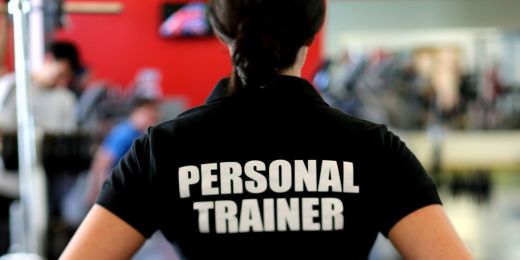




You're already asking these questions. Most of it is in your head, some of it is on a form you've been meaning to update since 2019, and the screening you'd want in writing if anything ever went wrong probably isn't written down at all. Five minutes of setup and the next person who says yes signs everything before they stand up.
$[[PRICE]] once. 30-day refund. Cheaper than one hour of a lawyer's time, which you should also spend.
TAKE THE CLEARANCE LETTER ANYWAY. It’s the letter you should be sending when a health screening turns up something — and the one most trainers never send, because writing it from scratch in front of a client is impossible. Blank, printable, yours to use with whatever forms you run today.
Add your first name and a valid email.